DEV-STATION
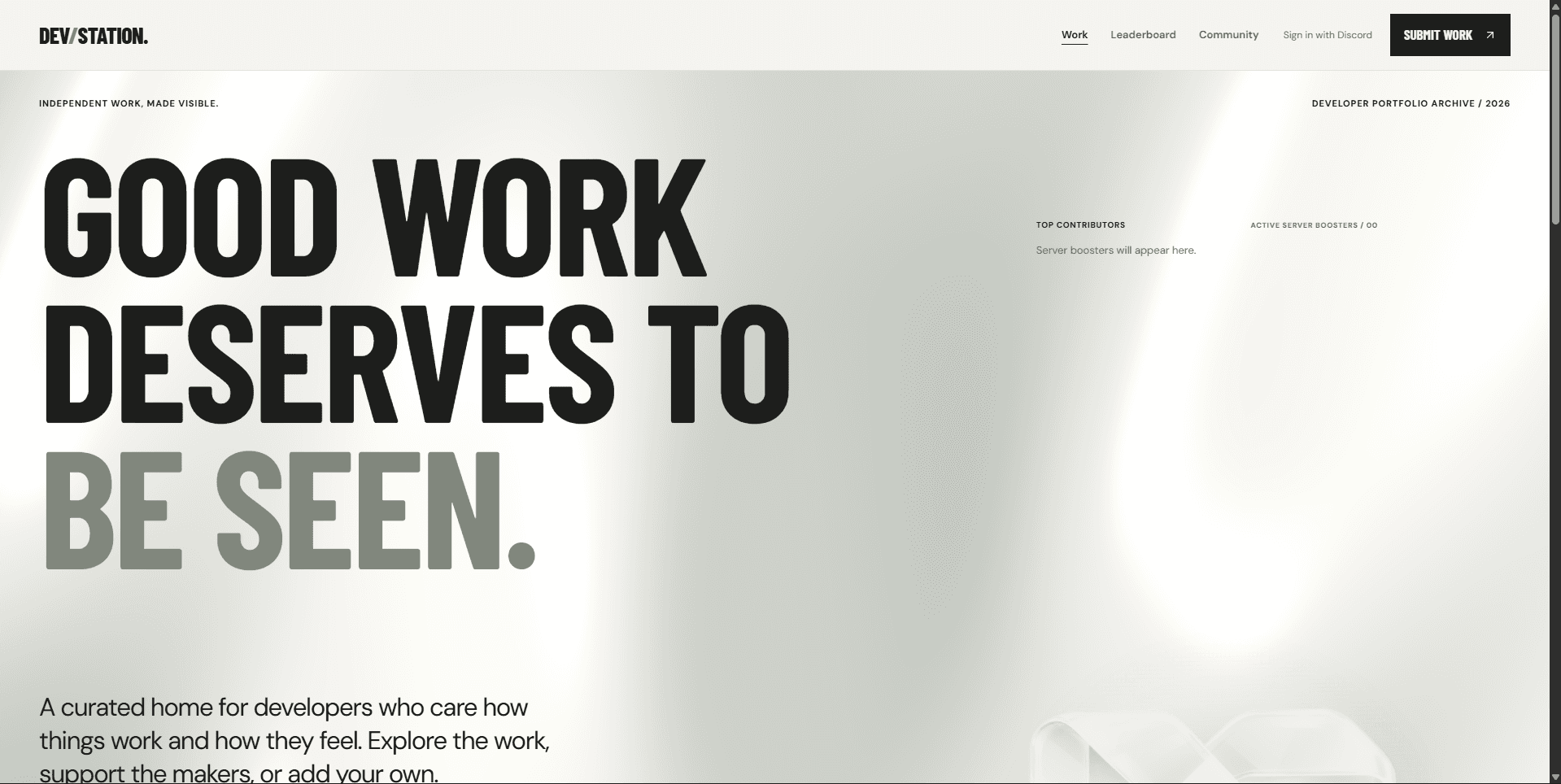
DEV/STATION is a curated archive for developer portfolios. I designed its editorial interface and built the system for submissions, live previews, structured ratings, saved work, weekly selections, and Discord-linked membership. It uses Next.js, Supabase, Cloudflare R2, Discord, and Vercel.
ENGINEERING IMMERSIVE NARRATIVES
DEV/STATION is a curated archive for developer portfolios. I designed its editorial interface and built the system for submissions, live previews, structured ratings, saved work, weekly selections, and Discord-linked membership. It uses Next.js, Supabase, Cloudflare R2, Discord, and Vercel.
[01] EXECUTIVE SUMMARY
DEV/STATION is an editorial archive and community recognition platform engineered specifically for creative developers and digital craftsmen. The platform bridges live multi-viewport project inspection with robust anti-abuse community voting, authenticated Discord membership synchronization, weekly curated editor selections, and high-performance asset distribution via Cloudflare R2.
[02] CASE STUDY 1 — DESIGNING A BETTER WAY TO EXPLORE PORTFOLIOS
MAKING THE WORK EASIER TO JUDGE
A portfolio screenshot can show visual style, but it cannot show how a site behaves. I built DEV/STATION around the idea that visitors should be able to inspect the work itself before rating it.
The interface takes cues from an editorial archive: large typography, a restrained palette, thin rules, and clear hierarchy. Each portfolio opens in a live viewer with desktop, tablet, and mobile widths, plus screenshots when a live embed is unavailable. Visitors can examine the project, read its context, and save it for later.
I also separated saving from rating. The heart is a personal bookmark; ratings use four criteria—design, interaction, performance, and originality. This gives members a more useful way to respond to creative development work than a single like count.
The result is a browsing experience built around the portfolio, with the site’s controls kept deliberately quiet.
[03] CASE STUDY 2 — BUILDING FAIR VOTING AND COMMUNITY RECOGNITION
CONNECTING THE ARCHIVE TO ITS COMMUNITY
DEV/STATION needed more than a gallery. Members had to sign in, submit work, rate portfolios fairly, and carry their identity between the website and Discord.
I used Discord sign-in through Supabase Auth and stored portfolios, ratings, and saved work in Supabase Postgres. Database rules enforce one rating per person per portfolio and a limit of ten ratings every 48 hours, so those rules still apply if someone bypasses the website interface. Portfolio images upload to Cloudflare R2 through short-lived signed URLs.
Recognition has distinct paths. Community picks come from current ratings, while reviewers publish three dated editor selections each week. Earlier selections remain in a Hall of Fame and cannot be picked again. Verified Discord server boosts can also give a portfolio premium recognition. Submission review and copyright reporting give admins tools to manage the archive as it grows.
This turned DEV/STATION into a connected portfolio and community system, rather than a collection of project cards.
[04] CORE DELIVERABLES & TECHNICAL SPECIFICATIONS
[05] TECH STACK

DEV/STATION Android
A dedicated mobile workspace for developer portfolios. Built with React Native and Expo, featuring floating dock navigation, SQLite cached browsing, encrypted on-device local drafts (24h retention), client-side image compression, and automated Android release pipelines.