Sonance Studio
A full-stack, distributed cloud video mastering and transcoding SaaS engineered to eliminate quality degradation and compression artifacts on short-form video platforms (TikTok, Instagram Reels, and YouTube Shorts) using Next.js 16, FFmpeg, Cloudflare R2/Queues, and Supabase.
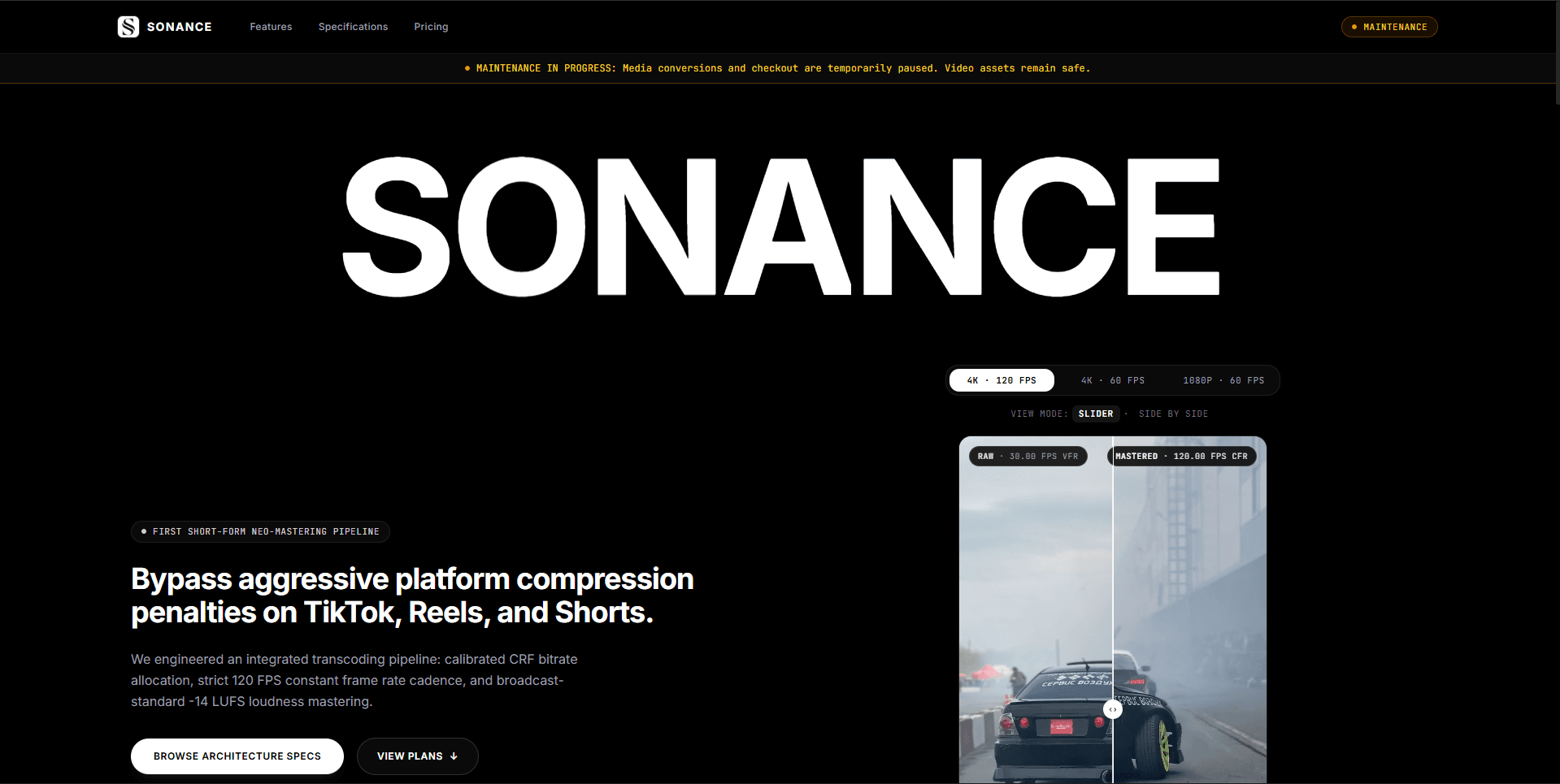
ENGINEERING IMMERSIVE NARRATIVES
Sonance Studio is a full-stack, distributed media optimization platform engineered to eliminate quality degradation and compression artifacts on short-form video platforms (TikTok, Instagram Reels, and YouTube Shorts).
[01] EXECUTIVE SUMMARY
By pre-conditioning raw mobile and cinema footage into the exact algorithmic ingest sweet-spots of social media transcode clusters, Sonance Studio prevents platform re-compression penalties, eliminates frame-rate jitter, normalizes audio to broadcast loudness standards, and optimizes container headers for instant playback.
[02] THE PROBLEM & PLATFORM COMPRESSION DILEMMA
Every day, social media platforms process billions of video uploads. To conserve bandwidth and edge compute, platform ingestion servers run aggressive automated transcode passes. When creators upload unconditioned video files, five catastrophic failures occur:
• Variable Frame Rate (VFR) Jitter: Smartphones record in VFR to save battery, causing playback micro-stutters and frame drops when converted by standard web compressors.
• Crushed Bitrate Allocation: Files with oversized bitrates trigger harsh, lossy downsampling that introduces severe macroblocking and motion blur.
• Audio Limiter Pumping: Unnormalized, high-peak audio triggers platform limiters, creating audible distortion, volume dips, and muffled dialogue.
• Color Range Mismatch: Unspecified RGB/YUV matrix tags cause color shifting and washed-out contrast during mobile decoding.
• Moov Atom Buffer Delay: Standard MP4 files store container headers at the end of the file, causing 2–4 second initial buffer latencies on mobile networks.
[03] THE SOLUTION: 4-STAGE NEO-MASTERING PIPELINE
Sonance Studio replaces generic web converters with a dedicated 4-stage mastering pipeline designed specifically around social platform encoder specifications:
1. CFR Cadence Lock: Strict 60.00 / 120.00 FPS hardware clocking regularizes all timestamps and eliminates VFR micro-stutter.
2. Calibrated CRF 18 Rate Control: H.264 High Profile Level 5.2 dynamically allocates bits to high-motion frames while remaining under platform re-encode thresholds.
3. Range-Aware Colorimetry: Explicit BT.709 matrix parameter injection preserves 100% color fidelity across OLED displays without washed-out blacks.
4. EBU R128 Audio Normalization: Automated two-pass loudness leveling targets -14.0 LUFS with a -1.0 dBTP True Peak ceiling, preventing platform limiter ducking.
5. Progressive Container Mux: +faststart shifts MP4 index headers (Moov atom) to the front of the file, eliminating buffer delay.
[04] KEY ARCHITECTURAL INNOVATIONS
• Range-Aware Colorimetry & BT.709 Tagging: Custom FFmpeg filter chains using in_range=full:out_range=limited alongside explicit -colorspace bt709 -color_primaries bt709 -color_trc bt709 -color_range tv injection.
• Distributed Asynchronous Worker Architecture: Direct client upload to Cloudflare R2 via IAM presigned URLs, asynchronous job dispatch via Cloudflare Queues, and an atomic state machine in Supabase PostgreSQL with job leasing and heartbeats.
• Fintech & Credits Engine (PayMongo Integration): Cryptographic webhook signature verification (paymongo-signature) with atomic credit reservations and regional payment methods (QRPH, GCash, Maya, Cards).
• Zero-Downtime Maintenance Interception: Edge Middleware route interception layer safely holding queue message leases and displaying friendly status modals without losing in-flight conversions.
[05] MEASURABLE OUTCOMES & BENCHMARKS
[06] TECH STACK
DEV-STATION
DEV/STATION is a curated archive for developer portfolios. I designed its editorial interface and built the system for submissions, live previews, structured ratings, saved work, weekly selections, and Discord-linked membership. It uses Next.js, Supabase, Cloudflare R2, Discord, and Vercel.